News
The Latest Travel Industry Updates from the Frontier of AI, GenAI Video, and Immersive Gaming
- October 30, 2025
WHY THE NEXT SHIFT IN AI DISTRIBUTION SHOULD MATTER TO HOTELS
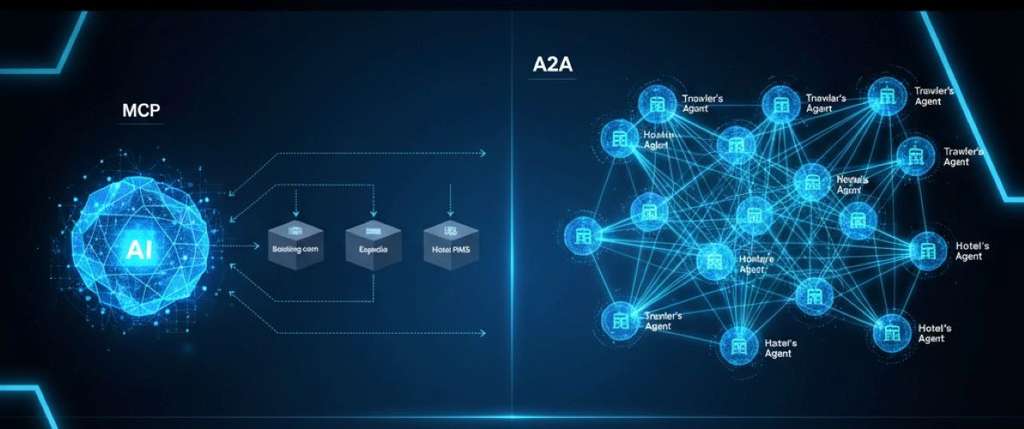
Over the past year, we’ve all been talking (and hearing) a lot about MCP, the Model Context Protocol. It’s the new standard introduced by Anthropic and now being adopted by OpenAI and Google — essentially a new, more intelligent way for AI models to connect to real-world data and tools.
For hotels, MCP represents the beginning of a new distribution era: one where booking engines, PMSs, and CRSs can plug directly into AI platforms like ChatGPT, allowing travelers to search, compare, and even book rooms within those conversational interfaces.
Then we started worrying about unauthorized access to our data. That’s how the concept of MCP-Identity (MCP-I) emerged. It adds a trust and identity layer on top of that wiring — defining who the AI (or the connected system) is, what permissions it has, and whether it can be trusted to access or exchange data.
But there’s an even bigger shift on the horizon — and it’s coming faster than most in our industry realize. It’s called A2A, short for Agent-to-Agent communication. And it could completely redefine who owns the customer relationship in the AI-driven travel ecosystem.
Let’s unpack what that means.
1. From data access to agent communication
Think of MCP as the “data access” layer of the AI world — a protocol that lets large language models (LLMs) securely connect to different sources of information. For example, when a traveler asks ChatGPT:
“Find me a family-friendly hotel in San Diego under $200 a night,”
ChatGPT can use MCP to connect to Booking Holdings (NASDAQ: BKNG), Expedia , or (eventually) directly to hotel systems — pulling live rates, availability, and content.
That’s powerful. But it’s still one-directional: AI → data source. The model pulls information, interprets it, and presents it to the user.
A2A (Agent-to-Agent) takes this a step further. Instead of just accessing data, AI agents will soon be able to communicate and negotiate directly with each other.
A traveler’s personal AI might talk to a hotel’s AI, discuss available room types, negotiate upgrades, check loyalty benefits, and confirm a booking — all autonomously.
That’s not science fiction. It’s already being tested. Amadeus Hospitality, for instance, reportedly has an A2A pilot in development.
2. Platforms vs. Protocols: who controls the conversation?
Right now, users don’t have personal agents in the technical sense. They use platform-provided agents — like ChatGPT (OpenAI), Gemini (Google), or Claude (Anthropic).
These platforms own the interface, the data, and the decision logic. Which means: they own the traveler.
That’s not so different from how OTAs control bookings today. Even if MCP opens up access to hotel data, the AI platform still decides which options appear first, which partners are integrated, and which offers the user sees. So yes — in the short term, OpenAI could become the next Expedia.
But A2A introduces a potential alternative future.
If agent-to-agent communication evolves under open, interoperable standards (rather than proprietary ones), travelers could eventually own their digital agents — or at least their data and preferences — and choose which hotel agents those interact with. Similar to how you “own” your email address and can send messages to anyone — whether they use Gmail, Yahoo, or another provider — thanks to the open SMTP protocol.
In other words, the protocol, not the platform, could define the rules of engagement. That would be a massive shift — from “platform-owned customers” to “user-owned digital relationships.”
3. Owning the digital identity: the new battleground
Let’s pause on that phrase: owning your digital identity.
In the traditional web, your digital identity was basically:
- Your login credentials (email, password)
- Your account profiles (Google, Facebook, Apple)
- Your data trail (cookies, history, preferences)
In the AI-driven web, your digital identity evolves into a persistent agent — a personalized AI that:
- Knows your preferences, past choices, values, and budget
- Can act on your behalf (search, compare, negotiate, book)
- Represents you in digital interactions
To own your digital identity (or agent) means:
- You control its data, memory, and behavior.
- You can move it between platforms (e.g., from OpenAI to Gemini).
- You decide who it interacts with (e.g., which hotel AIs it talks to).
- You can export, delete, or modify its memory.
It’s like having a digital passport that contains your AI’s “personality,” and you can take that passport anywhere — to another provider, to a metaverse world, or to a new device.
The opposite is what we have now: platform-owned identities, where:
- Your “AI agent” lives entirely inside OpenAI or Google’s ecosystem.
- You can’t take its memory or identity elsewhere.
- Its “loyalty” is to the platform, not to you.
If that digital identity is owned by OpenAI or Google, then those companies control the customer funnel. Hotels will once again find themselves paying for visibility and access — only this time, the middleman is an AI platform instead of an OTA.
But if digital identity becomes user-owned and portable (through open protocols and self-sovereign identity systems), then travelers could bring their agents anywhere — and those agents could talk directly to hotel agents without going through a central gatekeeper.
That’s the open web version of the AI future.
4. Wait, haven’t we already been through this before?
If this all sounds familiar, it’s because it is. The Web 3.0 movement — crypto, blockchain, decentralized identity — promised to “return power to the users”. The idea was:
- You’d own your data (no more Facebook mining it).
- You’d own your identity (no more logging in via Google).
- You’d own your content and transactions, verified on-chain.
The ultimate goal: a web where users, not platforms, are in control — through wallets, tokens, decentralized apps (dApps), and self-sovereign identities (SSI). But let’s be honest: that vision mostly failed.
In theory, it sounded revolutionary. In practice… well, people just wanted convenience. They didn’t want to run their own crypto wallet or host their own identity node. They just wanted things to work. So instead of using decentralized wallets or hosting our own nodes: we used Coinbase (a centralized exchange), we used OpenSea (a centralized NFT marketplace), we kept logging in via Google, Apple, and Facebook, because it’s easy.
Basically, we rebuilt new centralized gatekeepers on top of a decentralized dream. The result: The infrastructure was open — the adoption was not. And the reason is simple:
- Users care about convenience, not ideology.
- Platforms care about control, not openness.
- Developers go where users are — which reinforces the centralization loop.
The same risk exists now. Even if open A2A standards emerge, most travelers will default to whichever AI assistant is built into their phone or operating system. So once again, we’re on track to trade one centralized ecosystem (OTAs, Google) for another (OpenAI, Apple, or Google AI).
Unless we act.
5. What the hotel industry can (and must) do
Here’s what’s at stake: If OpenAI and Google end up controlling AI-based bookings, hotels will lose the direct connection to the guest — again — just as they did in the OTA era.
But it doesn’t have to be that way.
Here’s how the industry can respond:
- Engage in the standards conversation. Through groups like AHLA, HTNG, and the OpenTravel Alliance, we must advocate for open A2A standards that allow hotels to connect directly with traveler agents — on equal footing with OTAs.
- Develop industry-specific agents. Imagine an open, verified “hotel AI” layer that books direct and connects through standard protocols.
- Educate and prepare. Hoteliers need to understand these shifts now — not in 2027, when OpenAI is already taking commissions on bookings through ChatGPT.
The bottom line
We’re standing at a familiar crossroads.
- MCP opened the door for AI-driven bookings — giving platforms direct access to hotel inventory and data.
- A2A will decide whether those platforms remain the gatekeepers, or whether hotels and travelers can finally connect directly in an intelligent, autonomous ecosystem.
It’s the same battle we fought (and lost) during Web 3.0 — ownership vs. convenience — but this time, the stakes are higher. Because now, it’s not just your data being controlled. It’s your digital self and your day-to-day decision.
The question for our industry isn’t whether this transformation will happen. It’s who will own it.
By Ira Vouk
Hospitality Technology and Revenue Management consultant
HospitalityNet
Destinate creates professionally produced cinematic AI videos for major openings, launches, and pre-debut campaigns. Using a hybrid approach that blends GenAI, real-world assets, and creative direction, we help brands bring destinations, developments, and experiences to life before they open.
QUICK LINKS
SUBSCRIBE
To Our Ready, Player, Travel Newsletter Today
LOCATIONS
- NORTH AMERICA Los Angeles, USA
- LATIN AMERICA Mazatlán, Mexico
- ASIA Hong Kong, SAR