News
The Latest Updates from the Frontier of AI, GenAI Video, and Immersive Experiences
- December 3, 2025
HOLLYWOODS GEN AI SHAKEUP OF THE FILM AND TV INDUSTRY
After being invited to use OpenAI’s Sora and spending two weeks experimenting with it, I am convinced that we are at the precipice of a change so profound that it’s hard to comprehend fully, even as we watch it unfold. The launch and rapid evolution of generative AI video tools, led by Sora, have triggered a dual reaction: sheer wonder and palpable fear.
I found creating short videos with Sora AI to be remarkably simple and intuitive. I described a scene in which I stepped up to the plate at Yankee Stadium in Game 7 of the World Series and hit the game-winning home run for my beloved Yankees. Within minutes, Sora generated a cinematic version of that moment.
The level of realism in the lighting, movement, and crowd reaction makes it feel like I was actually there. The clips in this video show the kind of creative power that once required a production crew, now available with just a prompt and a few clicks.
On one hand, it’s easy to see the magic — the ability to type a few words and conjure worlds. On the other hand, it’s not difficult to see the immediate, tangible dangers. Recent studies have highlighted that tools like Sora 2 can be prompted to create false or misleading videos with alarming success, creating what one expert called “industrial-scale misinformation pipelines.”
Alongside this, we have the deeply personal, ethical nightmare of “likeness theft,” where our faces are no longer our own. As one chilling report from The Wall Street Journal detailed, a meteorologist found her identity stolen and used to create deepfakes to defraud her followers.
These concerns are not only valid; they are the most critical immediate challenge we face. Still, beyond this horizon of ethical and security battles, another, more structural disruption is brewing. Generative AI is aimed squarely at the entire entertainment production model, and in the long run, it has the potential to completely overturn the multibillion-dollar industry.
From Capture to Creation
We’ve seen this story before, just on a smaller scale. For the last 15 years, the smartphone — particularly high-end devices like Apple’s Pro iPhones and Samsung’s Galaxy line — democratized video.
Through the power of computational video, complex processes like image stabilization, real-time color grading, and portrait-mode depth-of-field were automated. A tool that once cost $100,000 was suddenly in everyone’s pocket, fueling the rise of the creator economy. It’s doubtful that even Steve Jobs saw this coming.
However, AI video is the next exponential leap. The smartphone democratized the capture of reality; generative AI democratizes its creation.
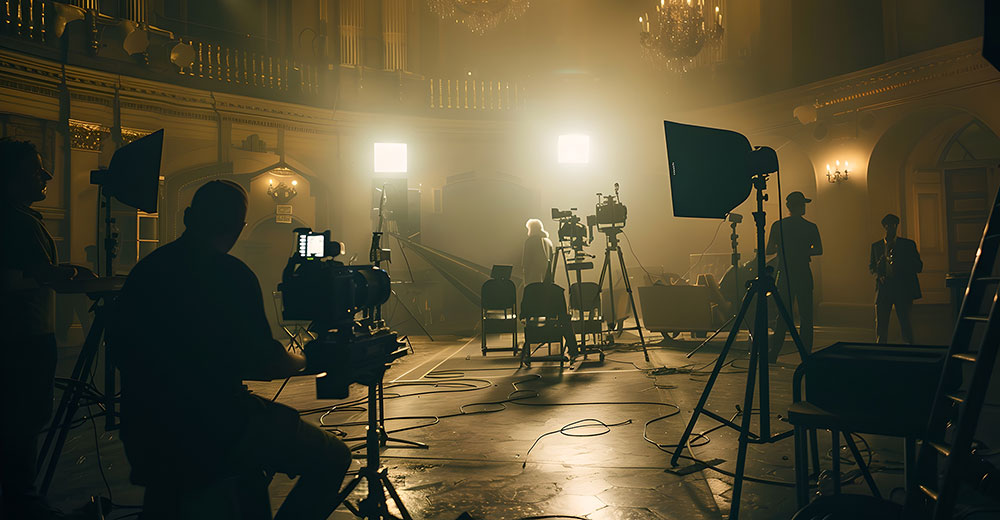
Think about what it takes to get a simple shot: a 1950s detective walking down a rainy street at night. You need a location scout, city permits, vintage cars, a wardrobe department, a rain machine, complex lighting rigs, and a camera crew. With generative AI, you just need a prompt.
Want an “impossible” shot — like a drone that flies through the window of a high-rise, down a hallway, and into a teacup? That would typically require a blend of expert drone pilots, set construction, and high-end special effects. Now, it’s just a matter of describing it.
This technology fundamentally uncouples visual storytelling from the constraints of physical reality. It removes the need to go on location, the need for practical effects, and, in many cases, the need for human actors.
The 50-Person Blockbuster
This new creative freedom leads directly to an economic earthquake.
For the last 25 years, the average professionally produced Hollywood film has employed a staff of roughly 300 to 500 people. These numbers include the principal cast, as well as the massive production crew infrastructure: grips, gaffers, cinematographers, sound mixers, location managers, transportation coordinators, caterers, and post-production teams.
In a world powered by generative AI, that number could easily plummet to less than 50. The very concept of a production crew will be radically redefined. AI will absorb much of the specialized labor traditionally required for physical production, and AI-generated video content will dramatically slash production costs, further democratizing the filmmaking process.
Suddenly, an independent filmmaker in their garage will have the power to create visuals that rival a $200 million blockbuster. The barrier to entry won’t be capital; it will be imagination.
Rise of the AI-VFX Director
To be clear, this doesn’t mean talent becomes obsolete. It means the talent shifts. The future of AI-produced film will place an unprecedented focus on the visionaries: the director and the cinematographer. Their jobs will become more crucial, not less, as they become the primary conduit between human ideas and AI execution.
The new requisite skill will be precision. Prompts for these tools will require highly specific, prescriptive, and technical direction. A director won’t just say, “I want a shot of a sad man.” They will need to write the shot with the vocabulary of a master cinematographer:
“Close-up on a 60-year-old man, face deeply lined. Key light is a single, flickering fluorescent overhead. Fill light is the blue glow of a television off-screen. Use an 85mm lens, shallow depth of field, and rack focus from his eyes to the wedding ring on his hand. Mood is isolated, reminiscent of Edward Hopper. Film grain to emulate Kodak Vision3 500T.”
The director becomes the sole source of intent, and their ability to articulate that intent in granular detail will define the quality of the final product.
The Computational Bottleneck
So why isn’t this happening tomorrow? Why are AI-generated clips limited to a minute or two? The answer is the same reason you can’t run a data center on a watch battery: the computational resources required are astronomical.
Generating a few seconds of high-fidelity, physically accurate, and coherent video requires immense processing power. Scaling that to a 120-minute feature film is, for now, cost-prohibitive, certainly at the mainstream user level.
However, this challenge is temporary. This bottleneck is the specific target of the most intense race in technology. Companies like Nvidia, AMD, and Qualcomm are in a furious battle to design the next generation of silicon solutions. Their goal is to create hardware that is more cost-efficient, more scalable, and explicitly optimized for this kind of AI-driven video workload.
As the cost of data center resources falls and the hardware becomes more powerful, the “one-minute” wall will crumble, and full-length AI-produced video will become an economic inevitability.
Collision Course to an AI ‘Toy Story’
This brings us to Hollywood’s front door, where significant pushback is already underway. The Screen Actors Guild (SAG) and other unions can hear the footsteps. The ethical fears are not abstract — they are the concrete, terrifying stories of actors and public figures whose digital likenesses are already being stolen and misused.
There is also deep skepticism that an AI-generated film can ever challenge a traditional film in quality, storytelling, and sheer production value. Can an algorithm truly capture the human soul?
This is where the revolution will need its Trojan Horse.
A full-scale AI film that attempts to replace living, working actors today would be met with unified, hostile rejection. A more likely path to acceptance will be a less threatening project — one that uses AI not to replace but to restore.
Consider a classic property, such as the Broadway musical “Man of La Mancha.” The 1972 film adaptation was a notorious critical and commercial failure, panned for poor casting and deviations from the beloved stage play. But what if AI could be used to create a new film version, one that digitally recreates the original, legendary 1965 Broadway cast?
Imagine seeing and hearing Richard Kiley and Joan Diener in their prime, in a fully realized cinematic world, offering audiences an immersive experience of a performance long lost to time. This application of AI feels less like theft and more like cultural preservation.
This scenario is the likely entry point. But to truly be accepted, AI-generated film needs what computerized animation required in 1995: its “Toy Story.”
When “Toy Story” was released, it upended the film industry. It didn’t just win a Special Achievement Academy Award; it proved that a computer-generated feature could be a work of genuine art, a masterpiece of storytelling that resonated with audiences on a deeply human level. It legitimized the entire medium.
AI-produced long-form content will not get the respect it needs until its own “Toy Story” moment arrives. It requires one, undeniable film that forces skeptics and unions alike to concede that a new art form has been born. When an AI-produced film wins its first Oscar, not for technical effects, but for Best Picture, the paradigm shift will be complete.
By Mark N. Vena TECH NEWS WORLD
Destinate creates professionally produced cinematic AI videos for major openings, launches, and pre-debut campaigns. Using a hybrid approach that blends GenAI, real-world assets, and creative direction, we help brands bring destinations, developments, and experiences to life before they open.
QUICK LINKS
SUBSCRIBE
To Our Ready, Player, Travel Newsletter Today
LOCATIONS
- NORTH AMERICA Los Angeles, USA
- LATIN AMERICA Mazatlán, Mexico
- ASIA Hong Kong, SAR