News
The Latest Updates from the Frontier of AI, GenAI Video, and Immersive Experiences
- February 16, 2026
AI’S IMPACT ON WORK AND LEARNING
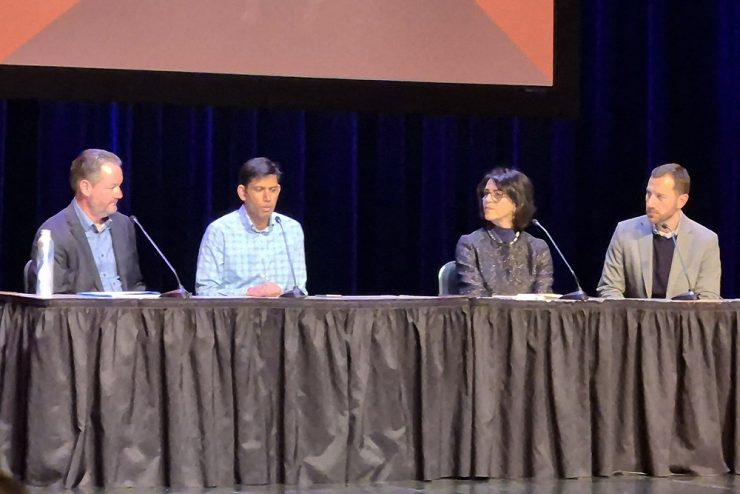
Panelists (from left): Paul Fain; Lav Varshney, director of the AI Innovation Institute; Marianna Savoca, associate vice president for career readiness and experiential education; and Nicholas Johnson, director of AI for Stony Brook University Libraries.
Will artificial intelligence eliminate jobs, reshape them or simply change how work gets done? The lack of consensus around those questions was the topic of a wide-ranging discussion at Stony Brook University, where speakers explored how AI is already influencing labor markets, education and the bridge between the two.
Campus community members gathered for a candid conversation about artificial intelligence and the future of work. Sponsored by the AI Innovation Institute (AI3), Stony Brook Libraries, the School of Communication and Journalism, the Office of the Provost and the Institute for Advanced Computational Science, and moderated by Margaret Schedel, chair of the Department of Journalism, the event featured veteran reporter Paul Fain, followed by a panel discussion with Stony Brook University leaders who are grappling with how AI is reshaping higher education, careers and daily work.
Fain, co-founder of Work Shift, a digital publication and news hub covering the intersection of training and employment, editor of The Job newsletter and host of The Cusp podcast, began the conversation by clarifying his background.
“I’m a reporter, and I always like to start by saying that means I’m not an expert and I’m also not an advocate,” he said. “But what I do is try to find people who are experts and get them to tell me what they know about AI and labor markets and jobs.”
His position and background, he explained, has become essential in a field where confidence often outpaces evidence. When Fain began reporting seriously on AI and labor markets about three years ago, he expected more clear and concrete answers. Instead, he encountered major gaps in reliable state and federal data. “I was kind of shocked to find out that there are very few people who actually have sound expertise on that,” he said.
What surprised him almost as much was the intensity of public reaction. “People have very strong feelings about AI, and I don’t fully understand that,” Fain said.
He described the conversation surrounding AI over the past year, much of which suggests that AI is already taking the place of entry-level work. “The general vibe about six months ago was that AI is hitting entry-level knowledge work very hard,” he said, referencing software development, finance, law, customer service and call centers.
Fear is already changing behavior, he noted. Fain described a conversation with a North Carolina community college president who saw a spike in enrollment in skilled trades. When surveyed, students shared those concerns: they wanted jobs that would not be replaced by AI.
Some of the most alarming predictions have come straight from the AI industry. Fain cited comments from Anthropic CEO Dario Amodei, who said that “in the next one to five years, 50% of entry-level jobs in the knowledge economy will be displaced.” While acknowledging that AI labs have incentives to emphasize the power of their tools, Fain said the claim resonates. “I think people took it pretty seriously, if you didn’t notice.”
The data behind predictions surrounding AI has grown more complicated, he noted. Early research, including Stanford’s Canaries in the Coal Mine report, identified a 13% relative decline in employment for early-career workers in AI-exposed roles. More recent analyses, including work from Yale’s Budget Lab, challenged the idea that AI was the primary reason behind this decline.
“The very strong consensus that has emerged in the last month or so is that the tightened, even frozen, labor market began before large language models were big enough to have that much of an impact,” Fain said, referencing interest rates and post-pandemic hiring slowdowns in technology fields.
Yet AI is clearly changing how work gets done. Citing a report from the Burning Glass Institute, Fain noted that “the jobs experiencing the most automation are simultaneously experiencing the most augmentation.” AI, he said, “isn’t eliminating project managers, it’s transforming what project managers do each day.”
Fain described forecasts that are sobering without being apocalyptic. A Forrester report projects a 6.1% loss of US jobs by 2030 due to AI and automation, roughly 10.4 million roles. “That’s obviously quite substantial,” he said, “but most people think it’s a relatively sober prediction.”
He cautioned against conflating financially driven layoffs with AI adoption. “AI is just the scapegoat,” he said, “at least today.”
The conversation turned to internships and apprenticeships, a concern raised by Marianna Savoca, associate vice president for career readiness and experiential education, during the panel discussion portion of the event. Savoca called the potential erosion of these pathways “horrifying,” emphasizing that applied learning is central to workforce readiness.
Fain shared that concern. “If the predictions that we heard at Davos from a wide range of people are true, you’re looking at the traditional model of developing young talent in knowledge sectors,” he said. “Hiring junior workers to perform routine tasks while they gain expertise over time will not survive because AI will be handling those tasks.”
He offered a personal example. At his small media organization, tasks once assigned to interns are now often handled by large language models, largely due to the financial aspect of using AI to replace labor. “It’s much cheaper to rely on AI to do a first draft than an apprentice,” he said.
Panelists from Stony Brook questioned Fain about what this means for education. Lav Varshney, Della Pietra Infinity Professor and inaugural director of the AI Innovation Institute, questioned whether creativity can be taught without deep foundational knowledge. “If you already have built up the muscle or the wisdom, AI tools are incredible,” Fain responded. “But if you haven’t, they’re not.”
Nicholas Johnson, director of AI at Stony Brook University Libraries, framed AI as both a productivity tool and a potential loss of professional community, pointing to the decline of platforms like Stack Overflow. Fain agreed that many are rethinking how AI should be used. “Some of the best advice I’ve heard lately is to not think about it as a tool to solve a discrete problem, but more as a creative thought partner,” he said.
Audience questions touched upon timelines, equity and policy. “I don’t think it’s a long timeline,” Fain said. “The next year or two is going to be really hard. So buckle up.”
When Fain was questioned on whether AI will democratize expertise or deepen divides, his answer was resolute. “Definitely both,” he said, adding that “not making a decision regarding AI is making a decision.”
The lecture and panel discussion were held February 9 at the Charles B. Wang Center Theatre as part of International Love Data Week, a global celebration dedicated to data in all its forms. This year’s Love Data Week runs from February 9 through 13 and is hosted at Stony Brook University by the Division of Educational and Institutional Effectiveness and facilitated by the Office of Educational Effectiveness.
By Beth Squire SBMatters
Destinate creates professionally produced cinematic AI videos for major openings, launches, and pre-debut campaigns. Using a hybrid approach that blends GenAI, real-world assets, and creative direction, we help brands bring destinations, developments, and experiences to life before they open.
QUICK LINKS
SUBSCRIBE
To Our Ready, Player, Travel Newsletter Today
LOCATIONS
- NORTH AMERICA Los Angeles, USA
- LATIN AMERICA Mazatlán, Mexico
- ASIA Hong Kong, SAR